Where the water appears tells you almost everything. There are four possibilities inside the glass, outside the glass, between the panes and on the frame and only two of them are a window problem. One of the four is actually a good sign.
It is worth knowing which of the four you have before you ask for quotes, because in the most common case replacing the window does not fix it. This article explains how to tell them apart and what to do in each case.

Where the water appears and what it means
| Where it appears | What it means | What needs fixing |
|---|---|---|
| Inside face of the glass | Indoor air too humid, or glass too cold | Ventilation and humidity, nearly always |
| Outside face of the glass | The window insulates very well and the outer pane stays cold | Nothing. It’s a good sign |
| Between the two panes | The seal of the glazing unit has failed | The glass, not the whole window |
| On the frame | A thermal bridge in the profile | The frame: typical of aluminium without a thermal break |
Why it forms, in two sentences
Warm air holds more water vapour than cold air. When that air touches a cold surface it cools abruptly, can no longer hold all that vapour and releases it as droplets. The temperature at which this happens is the dew point, and it depends on how much humidity there is in the house.
At 20 °C in the living room and 60 % relative humidity, any surface below 12 °C starts to condense. If humidity rises to 65 %, the threshold rises to 13,2 °C; at 70 %, to 14,4 °C. And a pane of glass with 5 °C outside sits at 8 – 10 °C.
That is why the window is where it shows first: it is the coldest surface in the room. Water forming there does not necessarily mean the window is at fault.
Indoor humidity → water appears below
At 5 °C outside, the glass sits between 8 – 10 °C below all three thresholds.
Where the water appears tells you what’s happening
1Inside the glass: the most common case
This is the one that worries people and the one that is almost never fixed by replacing the window. It means there is too much vapour in the house, the glass is too cold, or both. If it repeats every morning and nobody ventilates, it ends in black mould on the gaskets and around the frame.
2Outside the glass: a good sign
It appears at dawn in spring and autumn under a clear sky and vanishes as soon as the sun hits it. It means the window insulates so well that the heat inside no longer reaches the outer pane, and that pane cools the way a parked car cools. There is nothing to fix. It is literally proof the window is working.
3Between the panes: this one is the window
A permanent haze that cleans off neither inside nor out, because it is inside the cavity. It means the perimeter seal of the glazing unit has failed and the cavity has lost its airtightness. Ventilating and drying will not touch it.
The good news: usually only the glass unit is replaced, not the whole window. If someone proposes replacing the entire frame for this, get a second opinion.
4On the frame: a thermal bridge
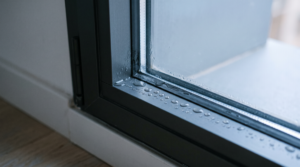
If the water is on the profile and not only on the glass, the frame is cooling below the dew point. That is typical of aluminium without a thermal break, and it is the clearest sign the joinery is not up to the job. Glass may sweat; the frame should not.
Why it sometimes appears right after new windows are fitted
This surprises a lot of people and is better said before it happens: it is normal, and it does not mean the new windows are faulty.
The old windows had gaps. Humid air escaped through them all day, without anyone noticing and without anyone deciding to. They ventilated the house at the cost of the heating bill. The new ones close, and that vapour from the shower, from cooking, from breathing, from laundry dried indoors stays.
The window did not create the moisture problem. It made it visible. The solution is not to have gaps again: it is to ventilate deliberately for a few minutes a day instead of accidentally for twenty-four hours.
What to do this week, in order
- Cross-ventilate for 15 – 30 minutes a day. Two opposite windows fully open, not one on the latch all day. For morning fog, 10 minutes is usually enough.
- Use the extractor in the shower, during and for a few minutes after, with the bathroom door shut.
- Don’t dry laundry indoors without ventilating. One load dried inside releases a couple of litres of water into the air.
- Put lids on pans and actually use the cooker hood.
- Heat the flat evenly. A closed, cold room next to warm ones is where the water always appears.
- Buy a hygrometer. It costs under ten euros and tells you whether you are in the 40 – 60 % band where you should be, or above 65 %, where the problems start.
If after two weeks of this the water still appears every morning, then it makes sense to look at the window.

When the window really is the problem
- The water is on the frame, not only on the glass.
- There is permanent haze between the two panes.
- You feel a draught with the window closed: the seal isn’t compressing and the glass gets colder than it should.
- You have fixed the ventilation, the hygrometer reads inside 40 – 60 %, and it still condenses daily.
- The glazing is single pane. No amount of ventilation fixes that.
What doesn’t work
- Blocking the ventilation grilles. It removes the airflow and multiplies the humidity.
- Moisture-absorbing sachets. They take up a few grams; one shower releases hundreds.
- Wiping the glass every morning and nothing else. It removes the symptom and leaves the cause.
- Turning the heating up without ventilating. Warmer air holds more vapour, and that vapour still finds the cold surface.
- Replacing the window without knowing which of the four cases you have. It is the most expensive way to solve nothing.
Frequently asked questions
Is it normal for new windows to condense more than the old ones?
Yes, and it is the most common complaint after an installation. The old ones had gaps that ventilated the house without anyone deciding to; the new ones close and the vapour stays in. The window did not create the humidity, it made it visible. It is corrected by ventilating deliberately for a few minutes a day.
Can condensation between the panes be fixed without replacing the window?
Almost always yes: the glazing unit is replaced and the frame stays. It is worth checking the frame and hardware first, but replacing an entire window because of a misted pane is rarely justified.
How much humidity should there be in a home?
Between 40 – 60 % relative humidity. Above 65 % condensation on the glass becomes systematic, and above 70 % the risk spreads to the walls and to mould. A ten-euro hygrometer will tell you.
Why does it only condense in the bedroom, and in the morning?
Because that is where the most hours of breathing happen behind a closed door with the heating off. Two people sleeping release a fair amount of vapour in eight hours, and the glass is at its coldest just before dawn.
Does condensation cause mould?
If it repeats and nobody ventilates, yes: first on the gaskets and around the frame, then on the wall. Above 70 % sustained humidity it is a matter of weeks. That is the real reason to deal with it, rather than the nuisance of the fog.
Read on
If you’re not sure which of the four you have
Send us a photo by private message. Just seeing where the water is on the glass, between the panes or on the frame settles it quickly, and we’ll tell you whether this is fixed by ventilating, by replacing the glass alone, or by replacing the window.
If it needs seeing in person, the survey is free and commits you to nothing. And if what you need is a repair rather than a new window, we’ll tell you there and then.
Send a photoor call us on +34 663 42 97 39